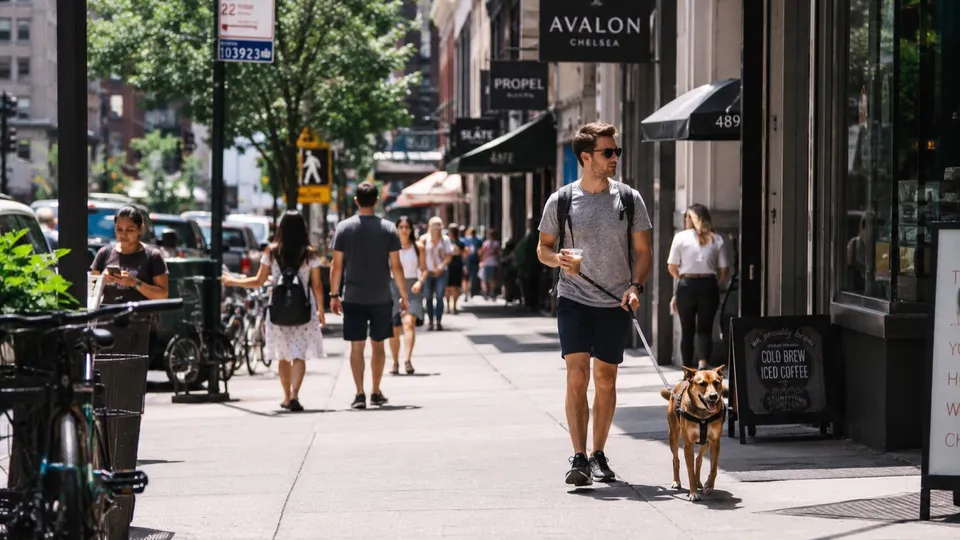
If you’re managing a reactive dog in a dense city, you’ve probably noticed that a lot of standard reactivity advice assumes room you don’t have. Suburban streets and open sidewalks allow you to cross to create thirty feet of distance from a trigger; a narrow city sidewalk between a building and a line of parked cars often doesn’t. This is a real constraint worth naming honestly, not something to train around as if it doesn’t exist — city walking calls for its own version of the standard approach, not a smaller copy of the suburban one.
This post is about the walk itself — unpredictable foot traffic, narrow sidewalks, constant novel triggers. It’s a companion to reactive dog training in an apartment, which covers building- and hallway-specific issues; this one picks up once you’re actually out the door.
Route planning is your primary tool
The single biggest lever you have in a city isn’t a training technique — it’s choosing where and when you walk in the first place, the same principle behind apartment hallway management applied to the whole route:
- Scout wider sidewalks where possible, even if it means a slightly longer route. A few extra feet of width is often the difference between a manageable pass and a forced close encounter.
- Use quieter side streets instead of main commercial corridors, even when the main street is the more direct path.
- Pick less-trafficked times of day — early morning and late evening walks typically have far less foot and dog traffic than midday or early evening in most dense areas.
None of this eliminates the problem entirely, but a deliberately chosen route with more width and less traffic reduces how often you’re forced into a close encounter you didn’t choose.
In-the-moment tactics for narrow sidewalks
When the route itself doesn’t give you enough room, a few tactics help you create space on the fly:
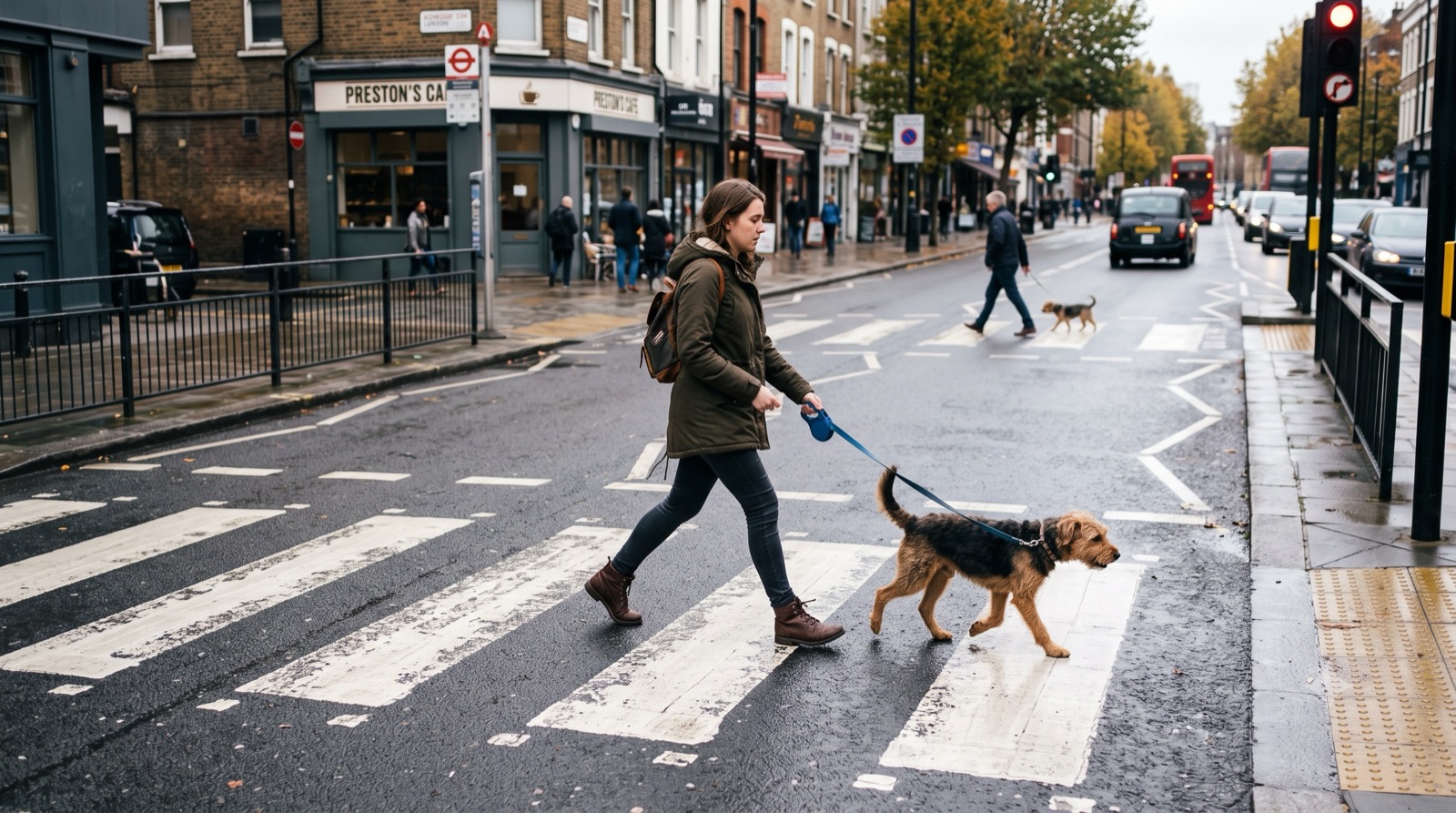
- Cross the street proactively, before a trigger gets close, rather than waiting to see if a pass will go fine. Deciding early gives you more room to maneuver than waiting until the gap has closed — the AVSAB Position Statement on Humane Dog Training specifically recommends proactive management over waiting for a reaction to occur.
- Use doorways and gaps between parked cars as brief pull-offs. Stepping into a doorway alcove or the gap between two parked cars for a few seconds can let a trigger pass at a distance, even on a sidewalk too narrow to actually cross the street.
- Walk on the outside, street side of your dog, putting your body between your dog and foot traffic. This gives your dog a small extra buffer from passersby without needing any additional space on the sidewalk itself.
The U-turn technique covered elsewhere on this site applies directly here too, and doesn’t need reinventing for city use — the same cue-and-redirect mechanics work whether you’re avoiding a dog on a suburban street or a stranger on a crowded sidewalk.
The “no avoiding it” reality of dense cities
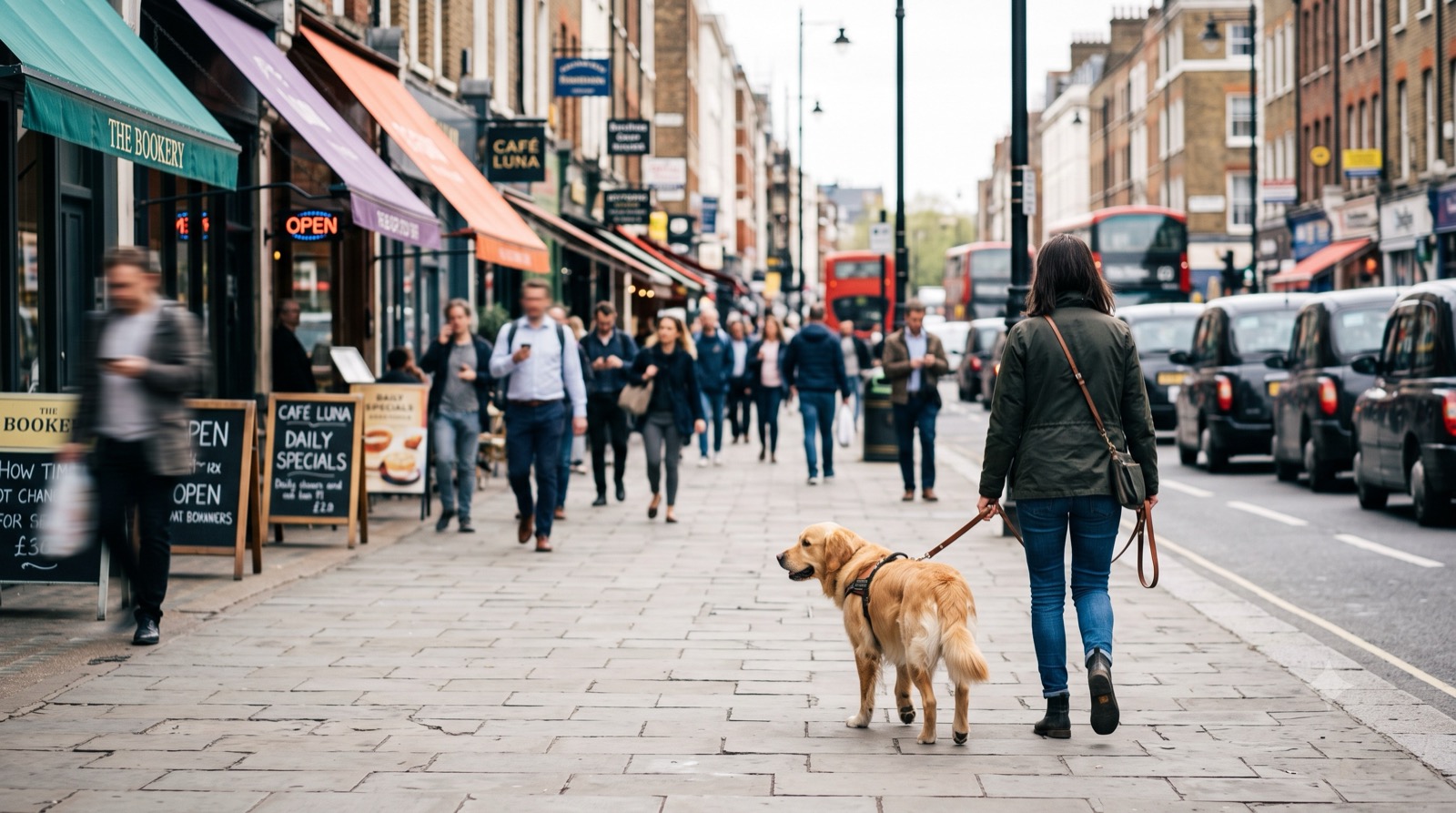
It’s worth setting honest expectations: some days in a genuinely dense city will simply have more triggers than can be managed perfectly, no matter how well you plan the route or how skilled you get at pull-offs and proactive crossings. A city block at rush hour, a sidewalk sale, a busy weekend morning — these will sometimes produce more close encounters than you can fully prevent. That’s a normal part of city life with a reactive dog, not a sign your training or management is failing. Judge progress over weeks and routes, not by whether any single walk went perfectly.
Dog parks and off-leash areas as a separate outlet
Because dense cities often create a real “nowhere to decompress” problem — no yard, narrow sidewalks, constant low-grade vigilance on every walk — a fenced dog park or off-leash area your dog does well in is worth treating as a distinct, valuable outlet rather than an occasional extra. This isn’t about training reps; it’s about giving your dog real recovery time in a way that pure leash-walking in a crowded environment can’t provide. See letting your dog sniff and set the pace for the broader case for this kind of low-structure recovery time, and treat a good off-leash space as one of the more direct ways to get it in a city setting specifically.
When to bring in a professional
If narrow-sidewalk encounters are happening so often that you can’t find workable routes or times, or if your dog’s stress seems to be climbing rather than settling despite consistent management, that’s worth raising with a certified force-free trainer — someone familiar with dense urban environments specifically can often suggest routes, timing, or techniques you haven’t tried.
Related reading
For the core method behind working at a safe distance in the first place, see finding your dog’s threshold distance. If strangers on the sidewalk are the specific trigger making crowded routes hard, see dog reactive to strangers approaching.