If you live in an apartment with a reactive dog, you’ve probably had this exact moment: you open your front door, and there’s another dog in the hallway, six feet away, with nowhere to go. No yard to retreat to. No side street to duck down. Just a narrow hallway and a dog who’s about to lose it.
Most reactive dog training advice assumes you have a fenced yard and quiet suburban streets to practice on. You don’t have that, and it’s not the reason your dog isn’t improving. Apartment life just means you need a different plan — one built around tight spaces, shared hallways, and neighbors who show up without warning.
Here’s how to actually work with that, not around it.
First, understand why apartments make reactivity harder
It’s not your imagination — apartment living genuinely stacks the odds against a reactive dog in a few specific ways:
- No buffer distance. Reactivity training is built on distance from the trigger, consistent with the AVSAB Position Statement on Humane Dog Training’s emphasis on managing exposure at a distance the dog can cope with. Hallways, elevators, and shared entryways often don’t give you that option.
- Surprise encounters. You can’t control when a neighbor’s dog appears around a corner, so you lose the ability to set up controlled practice sessions.
- Repeated exposure to the same triggers. If your dog reacts to one specific neighbor’s dog, you may pass that same dog multiple times a day, which can reinforce the pattern instead of breaking it.
None of this means training won’t work. It means the setup matters more than it would in a house with a yard.
Step 1: Manage the environment before you train the dog
Management isn’t giving up — it’s preventing your dog from rehearsing the reactive behavior while you build new skills. Every time your dog fully reacts, that pattern gets a little more practiced.
Practical apartment management moves:
- Check hallways and stairwells before you open the door. A few seconds of listening for jingling collars or footsteps can help you avoid a surprise encounter.
- Use a frosted window film or keep blinds down if your dog reacts to movement outside a ground-floor window.
- Pick off-peak walk times for the first few weeks — early morning or later evening, when foot traffic in shared spaces is lower.
- Talk to your building. Some buildings have a designated “quiet” stairwell or side entrance. It’s worth asking.
This step alone often reduces the number of reactive episodes per week, which gives training room to actually work.
Step 2: Build a “hallway protocol” for surprise encounters
You can’t always avoid a surprise. So instead of hoping it won’t happen, decide in advance what you’ll do when it does.
A simple protocol:
- Turn your body sideways to block your dog’s direct line of sight to the trigger, and take a step back if space allows.
- Say a cue word you’ve already practiced at home (many trainers use “this way” or “let’s go”) and move toward any exit — a doorway, a stairwell, around a corner.
- Don’t wait to see what your dog will do. By the time you can tell a reaction is starting, you’re already past the point where redirection is easy. Move first, assess second.
- Reward calm, not perfection. If your dog notices the other dog but doesn’t fully react, that’s the behavior to reward — heavily, with real enthusiasm.
Practice this protocol at home first, with no trigger present, until the cue word and movement feel automatic to both of you.
Step 3: Create “practice reps” you can control
Real training progress comes from repetitions where you control the variables — distance, duration, and intensity of the trigger. In an apartment, you have to build these deliberately:
- Ask a friend with a calm dog to help, standing at a distance you choose (often much farther than you’d expect — 30-plus feet for many dogs) while you reward your dog for staying calm.
- Use parked cars, a lobby, or a nearby parking lot as a substitute for a yard — anywhere you can control distance and have an exit route.
- Keep sessions short. Five focused minutes of controlled practice most days beats one long, overwhelming walk.
The goal isn’t to eliminate every reaction overnight. It’s to slowly move the distance at which your dog can stay under threshold — the point past which they can’t think, only react.
The goal isn't to eliminate every reaction overnight. It's to slowly move the distance at which your dog can stay under threshold.
Step 4: Set up your home as a decompression zone
Dogs living with unpredictable hallway encounters are often running on elevated stress hormones without a lot of recovery time. Give your dog a predictable, low-stimulation space at home:
- A crate or covered bed away from the front door and windows
- A consistent daily sniff-and-explore walk somewhere quieter — a park, a trail, even a slow lap around a quiet block — with no training goals, just decompression
- Predictable daily structure, since routine itself lowers baseline stress in many reactive dogs
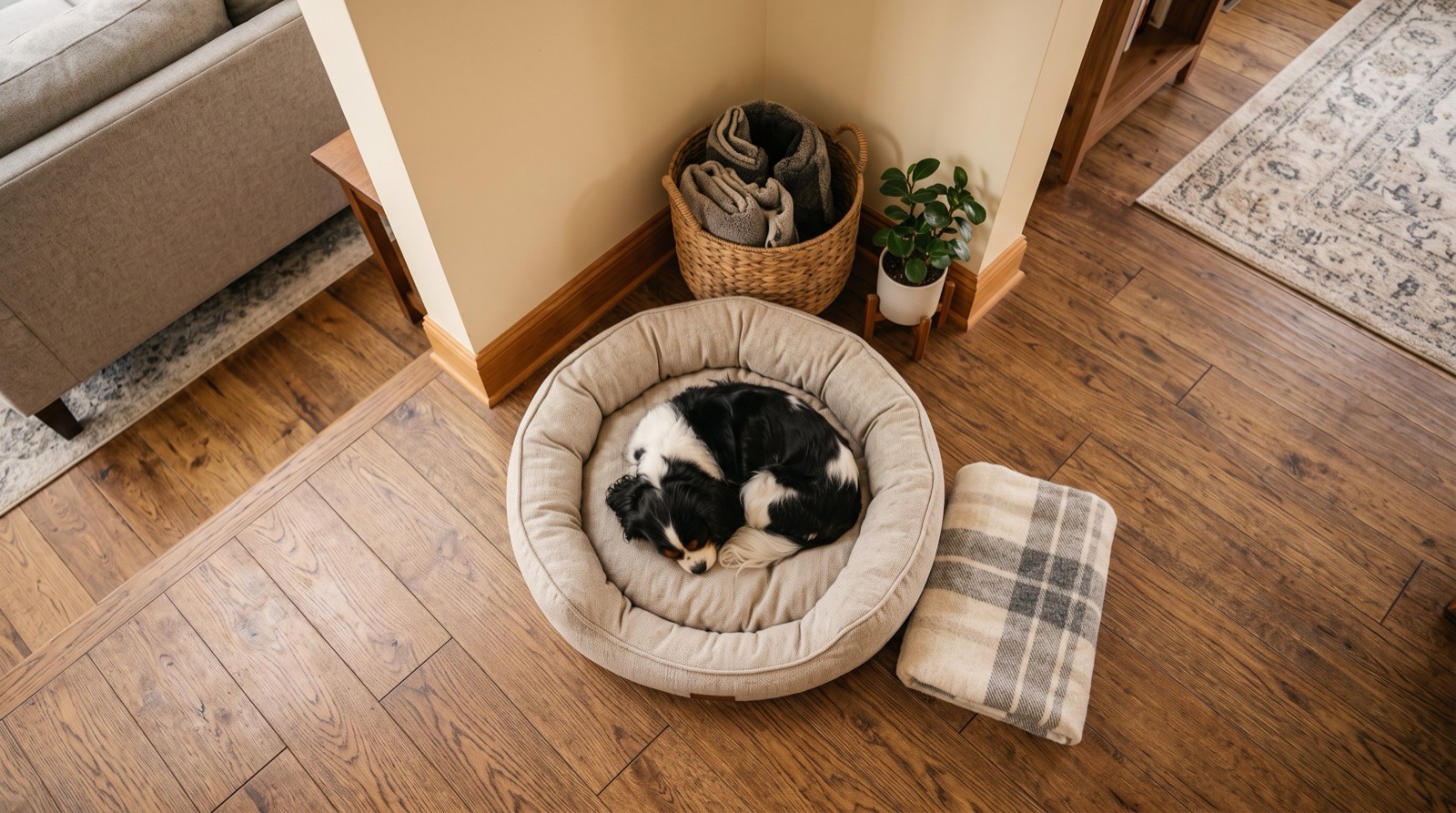
This part often gets skipped because it doesn’t feel like “training,” but a dog who never gets to come down from alert-mode has a much harder time learning anything new.
What to expect, realistically
Progress in apartment settings is usually slower and less linear than advice written for houses with yards — not because your dog is a harder case, but because you have less control over your dog’s environment. Expect setbacks after a surprise encounter. Expect some weeks to feel like no progress at all. That’s normal, not a sign you’re doing it wrong.
If your dog has a bite history, is reacting with intensity that scares you, or the reactivity is getting worse despite consistent management, that’s the point to bring in a certified force-free trainer or veterinary behaviorist rather than trying to solve it solo — apartment logistics make in-person, personalized coaching especially useful, since a trainer can walk your specific hallway with you.
Next steps
Once your hallway protocol feels automatic and you’re getting a few clean practice reps a week, the next skill to build is finding your dog’s actual threshold distance — the exact point where they notice a trigger but can still think clearly. That’s covered step-by-step in how to find your dog’s threshold distance.