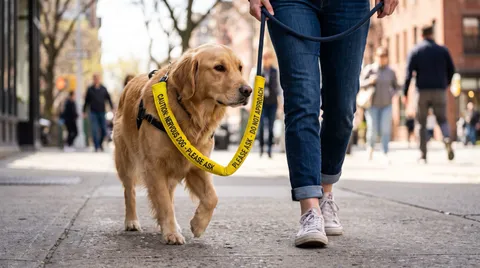
If your dog explodes at the sight of another dog on a walk but turns into a completely normal, social dog the second the leash comes off, you’re not dealing with a contradiction — you’re dealing with barrier frustration. It’s one of the most common and most misunderstood forms of reactivity, and it responds to different training than fear-based reactivity does.
Why the leash itself is the trigger
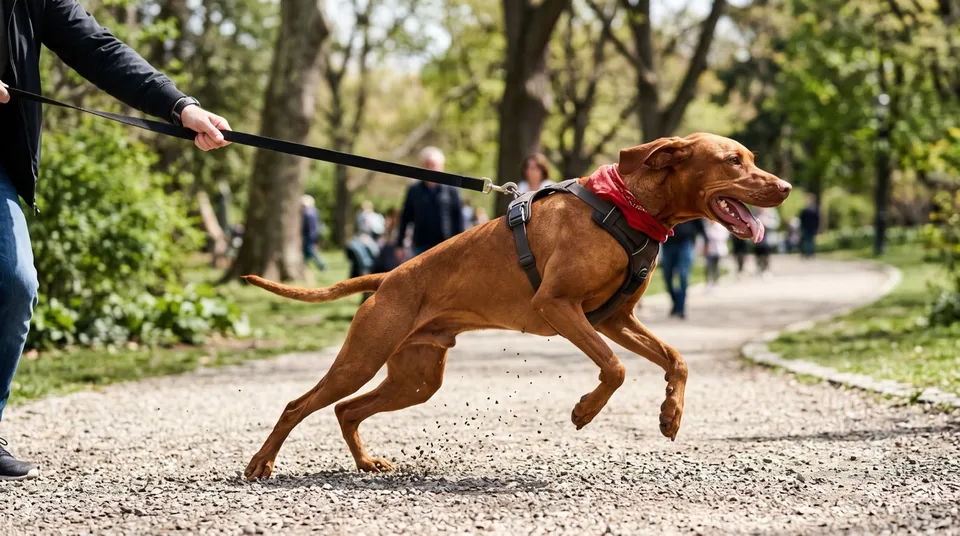
Most reactivity advice assumes a dog who wants distance from something scary. Frustration-based reactivity is close to the opposite: your dog wants to get to the other dog, usually to greet or play, and the leash is physically stopping them. That gap between “I want to go say hi” and “I’m stuck six feet away” builds arousal fast, and the arousal comes out looking exactly like aggression — barking, lunging, a stiff, forward body.
That gap between "I want to go say hi" and "I'm stuck six feet away" builds arousal fast, and the arousal comes out looking exactly like aggression.
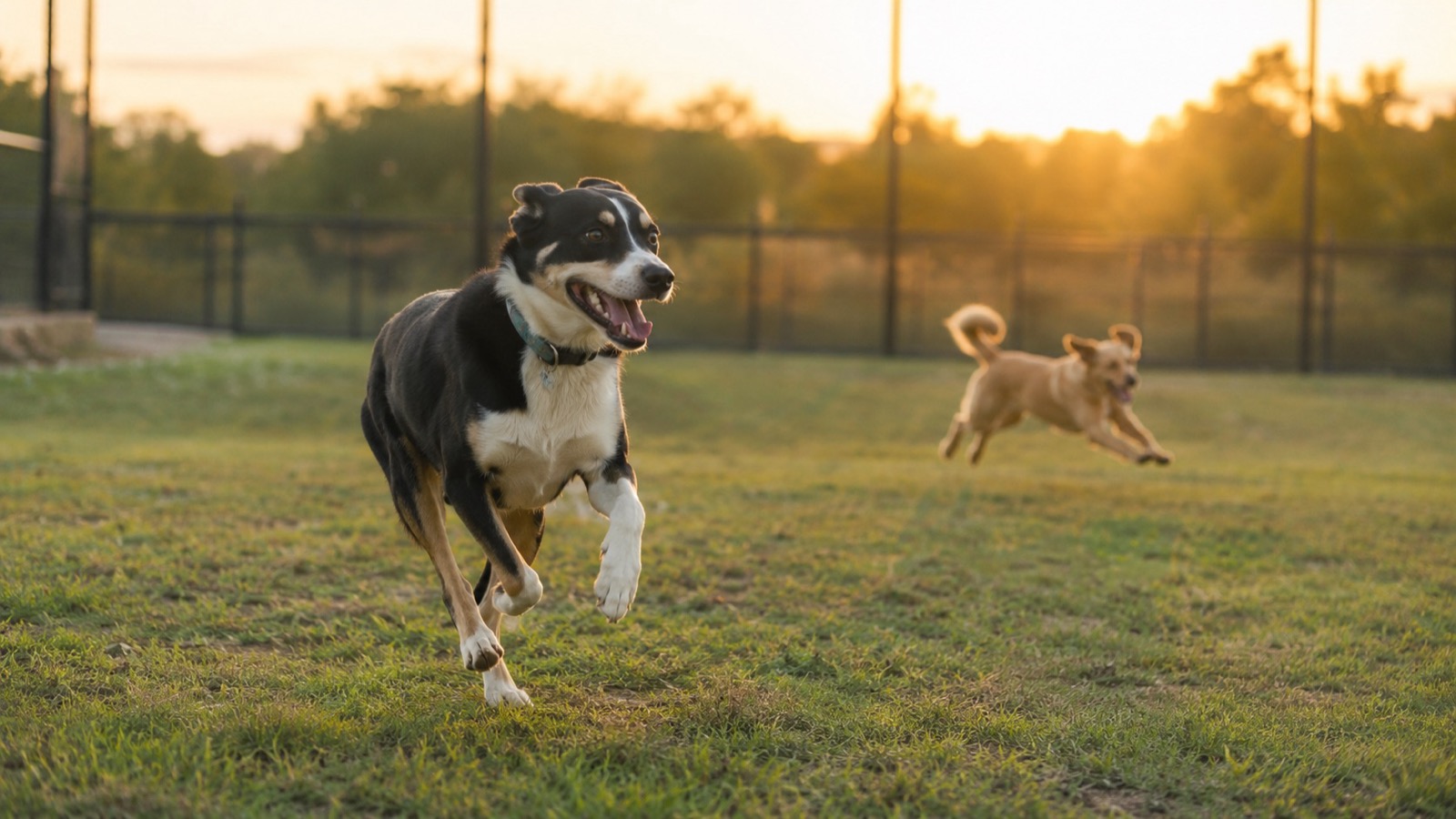
Off-leash, that gap doesn’t exist. Your dog can just go say hi, so there’s nothing to be frustrated about, and the reactivity disappears. This is the single biggest tell that you’re looking at frustration rather than fear.
Frustration-based vs. fear-based: how to tell them apart
Both can look similar from a distance — noise, lunging, a dog who seems out of control — but a few things separate them:
- Body language. A frustrated dog usually has a forward-leaning, bouncy, high-tail posture, sometimes with a wagging tail mixed into the barking. A fearful dog tends to lean back, tuck, have a lowered tail or pinned ears, even while barking or lunging.
- General sociability. Frustration-reactive dogs are often the dogs who love other dogs — at the dog park, at daycare, off-leash on the trail. Fear-reactive dogs are usually more selective or avoidant even in low-pressure settings.
- What happens when the barrier is removed. This is the clearest test. If your dog reacts on leash but plays normally the moment they’re off-leash and can approach freely, frustration is very likely the driver. A fear-based dog doesn’t suddenly relax just because the leash is gone — they may still avoid, freeze, or need space.
- What happens after a greeting. A frustration-reactive dog often calms down quickly once they’ve made contact. A fear-reactive dog rarely does.
If you’re not sure which you’re dealing with, that uncertainty is worth bringing to a professional rather than guessing — see the note at the end of this post.
Why generic distance-and-desensitization advice under-serves this dog
Most reactivity content — including the threshold-distance method that’s genuinely the right starting point for fear-based cases — is built around gradually reducing sensitivity to a scary trigger. That’s the correct framework when a dog wants distance.
It’s a mismatch for a frustration-reactive dog, because the problem was never “this is too scary, get further away.” The problem is “I want that thing and I can’t have it.” Standing 40 feet from a dog your dog wants to play with doesn’t reduce fear — there’s no fear to reduce — it just holds your dog at the edge of frustration for longer, which can make the barking and lunging more practiced, not less. Distance work still matters here, but it needs to be paired with impulse control training, not used as the whole plan.
Start with a “no on-leash greetings” policy
This is the part that surprises people, because it feels backwards: even if your dog’s on-leash greetings usually go fine, stop doing them. A few reasons this matters:
- It removes the payoff for the exact behavior you’re trying to reduce. If barking and lunging sometimes end in “and now you get to say hi,” you’re reinforcing the outburst on a variable schedule — which is the hardest kind of behavior to extinguish.
- On-leash greetings are higher-risk than they look. Two leashed dogs meeting head-on removes a dog’s ability to retreat or circle, which is normal, calming body language in an off-leash greeting — a point the AVSAB Position Statement on Humane Dog Training makes directly about proactively managing setups that remove a dog’s normal coping options. Even friendly dogs can tip into a scuffle in that setup.
- It’s inconsistent otherwise. A dog who sometimes gets to greet on leash and sometimes doesn’t has no reliable rule to learn. A flat “we don’t greet on leash, ever” is easier for your dog to understand than “sometimes.”
This isn’t forever — it’s a management rule while you build the skills below. Off-leash greetings in appropriate settings (a fenced area, a friend’s calm dog, a dog park if your dog does well there) are still fine.
Build impulse control as a general skill
Frustration-based reactivity often shows up in other contexts too — at the door, over food, waiting for a toy to be thrown — because the underlying skill missing is tolerating a delay between wanting something and getting it. Building that skill generally makes the leash version easier:
- Reinforce a default sit or check-in. Reward your dog, unprompted, for offering a sit or glancing at you instead of pulling toward something they want. Do this constantly in low-stakes moments — before meals, before going through doors, before toys — so it’s automatic before you ever need it near a trigger.
- Add small delays before your dog gets what they want. Ask for a sit, wait a second or two longer than feels necessary, then release them to the thing they wanted (the door, the toy, the food bowl). Gradually stretch the delay over weeks. You’re teaching your dog that calm behavior — not pulling or barking — is what makes good things happen.
- Practice away from triggers first. Impulse control work should be boring and easy at home before you ever ask for it near another dog.
The engage-disengage game
This is one of the most useful specific exercises for frustration-based dogs, and it works well alongside the impulse control work above:
- At a distance where your dog notices another dog but can still take treats and respond to you (their threshold), wait for your dog to look at the other dog.
- The moment they voluntarily look away from the trigger back toward you — even for a split second — mark it (“yes!”) and reward.
- Repeat. Over time, your dog starts offering that look-back more quickly and more often, because they’ve learned that noticing a dog and then checking in with you is what pays off.
The goal isn’t to stop your dog from noticing other dogs — that’s unrealistic and unnecessary. It’s to build a habit of disengaging on their own instead of fixating and escalating.
U-turns and treat magnets for surprise encounters
Controlled practice sessions are useful, but real walks include dogs you didn’t plan for. Two tools for those moments:
- The U-turn. Practice this at home with no trigger present until it’s automatic: say a cue word (“this way,” “let’s go”), turn and walk the opposite direction, and reward your dog for coming with you. When a surprise dog appears, use it immediately — before your dog has fully locked on, not after.
- The treat magnet. Get a treat right at your dog’s nose and use it to lure them past or away from the trigger while walking, keeping their focus low and close to you until you’re clear. This isn’t meant to be a long-term crutch — it’s a way to get through an unplanned encounter without a full-blown reaction, so you can go back to structured training afterward.
Both work better the earlier you use them. Once a frustration-reactive dog is fully fixated and vocalizing, redirecting gets much harder — the goal is to interrupt the buildup, not compete with it.
When to bring in a professional instead of relying on this post
If you’re not confident distinguishing frustration from fear, if your dog’s on-leash behavior is escalating despite consistent management, or if a leashed encounter has ever come close to an actual altercation, that’s the point to work with a certified force-free trainer or veterinary behaviorist in person rather than troubleshooting from an article. Frustration and fear can also coexist in the same dog, and sorting that out reliably usually takes someone watching your dog’s actual body language in real time.
Related reading
If you’re working through this in a tight apartment setting with limited room for controlled practice reps, see reactive dog training in an apartment for hallway-specific protocols. If a multi-dog household is part of this picture, see my dogs get along at home but one is reactive on leash.