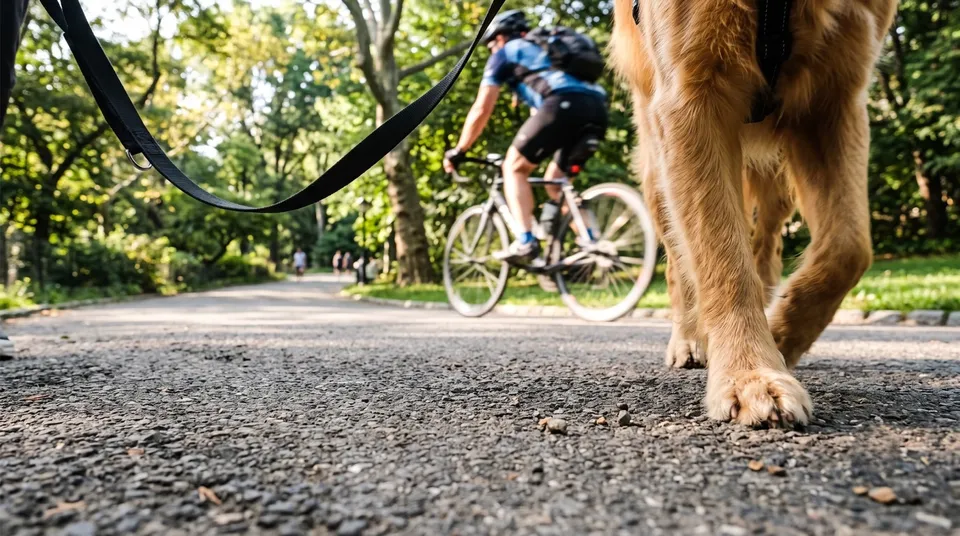
If your dog loses it over bikes, skateboards, scooters, rollerblades, or strollers, you’re dealing with a different instinct than most dog-to-dog reactivity. Fast, erratic, wheeled movement taps directly into prey drive or a startle response, and skateboards specifically combine a rattling, unpredictable noise with flickering, jerky motion that’s especially hard for a lot of dogs to process calmly.
Why wheeled triggers are different
Most of the reactivity content on this site is built around dog-to-dog encounters, where the mechanism is usually fear or frustration. Bikes and skateboards often engage something more primal: a fast-moving object darting past can trigger a chase response the same way a fleeing squirrel or rabbit would, regardless of whether the dog has any real interest in the person riding it. Skateboards add a second layer — the rattling wheels and irregular, start-stop motion as a rider pushes off and coasts make the trigger harder to predict and track than a bike’s steadier movement, which can push the reaction higher for dogs who are otherwise fine with regular cyclists.
Telling chase drive from fear
These two mechanisms call for different training approaches, so it’s worth learning to read which one you’re looking at:
- Chase-driven dogs typically show a stiff, forward-leaning body with locked, intense focus on the moving trigger — the posture of a dog gathering to move, not a dog trying to create distance.
- Fearful dogs typically show the opposite: a tucked tail, backing away or trying to retreat, and sometimes “whale eye” — the whites of the eyes visible as the dog watches the trigger without turning their head fully toward it.
Chase-driven reactivity responds best to impulse-control work — building the dog’s ability to notice a fast-moving trigger and choose not to act on the urge to chase. Fear-driven reactivity needs the safety- and confidence-building approach used elsewhere on this site: distance, patience, and letting the dog’s stress come down before asking for anything. Treating a fearful dog’s reaction like a chase-drive problem (or vice versa) tends to stall progress, so figuring out which one you’re seeing is worth doing before you start.
Stage one: stationary practice, indoors or in a controlled space
Start with the bike or skateboard completely still, not moving:
- Set the object down at a distance where your dog can look at it calmly — a driveway, garage, or quiet room works fine.
- Reward calm observation: your dog notices the bike or skateboard, doesn’t react, and gets a treat for that.
- Only introduce any movement once your dog is genuinely relaxed around the stationary object across multiple sessions, not just tolerating it.
Resist the urge to force closer contact to “get it over with” — walking a dog right up to a skateboard to prove it’s not scary tends to make fear worse, not better, since it skips past the dog’s actual capacity to cope and just floods them with the trigger at full intensity.
Use engage-disengage once movement is introduced
Once you’re working with actual movement — a bike rolling past, a skateboard in motion — the engage-disengage game covered elsewhere on this site applies directly here and doesn’t need reinventing: reward your dog for noticing the moving trigger and voluntarily looking back at you, building the habit of checking in rather than fixating or chasing.
A structured exercise: place-and-circle
This is a specific drill worth setting up deliberately:
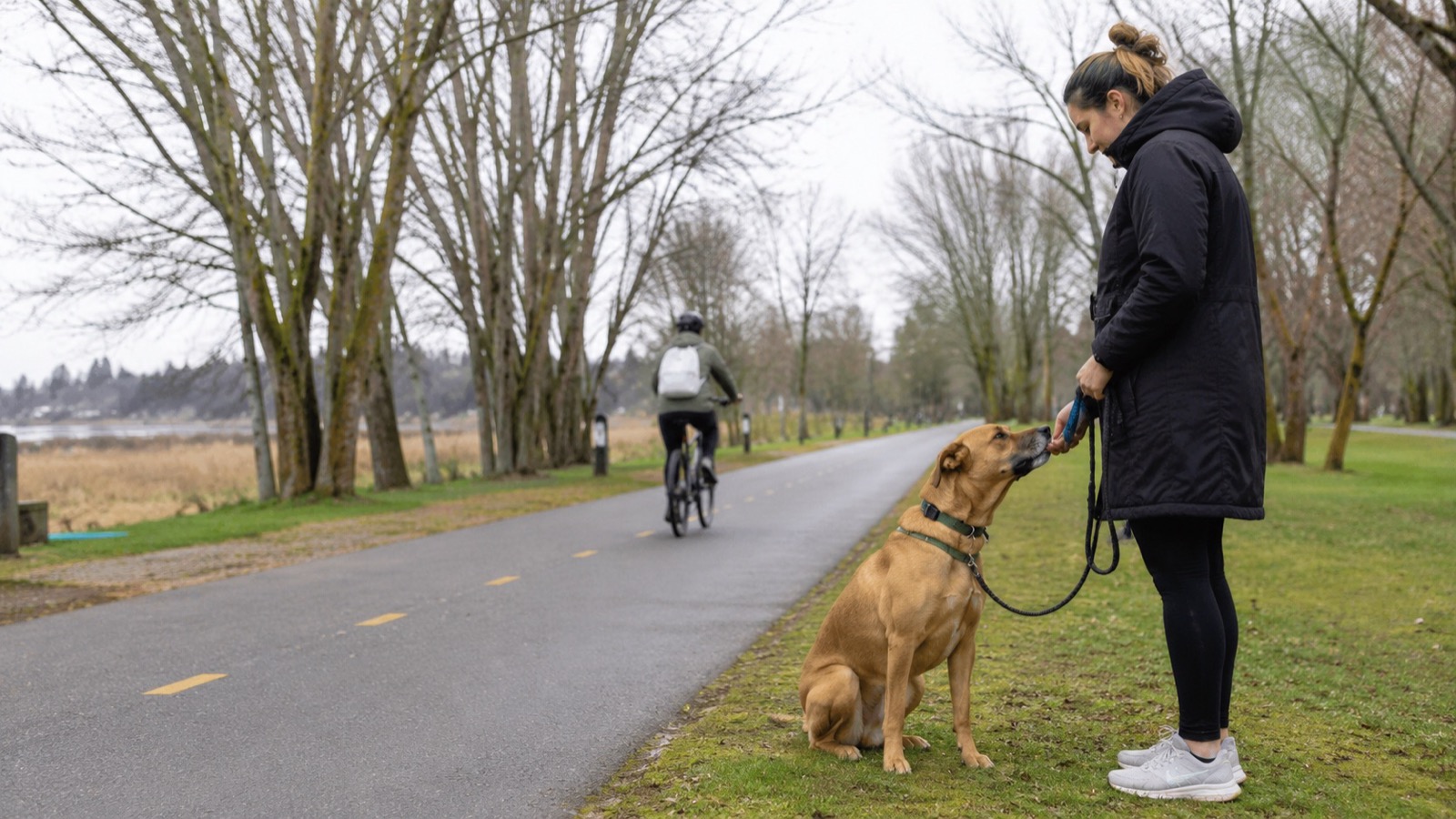
- Ask your dog for a “place” or stay behavior — settled on a mat, bed, or designated spot.
- Have a helper ride a bike in a wide circle at a distance your dog can handle without breaking the stay or showing stress.
- Reward your dog for holding the stay while the bike is in motion at that distance.
- Only decrease the distance gradually, across sessions, once your dog is reliably settled at the current distance — the same incremental logic used in threshold distance work generally.
This exercise is useful because it isolates impulse control specifically — staying settled while something exciting or startling moves nearby — rather than combining it with the added complexity of your dog also being on the move.
The hard part: generalizing to the real world
Controlled practice is where this training starts, but it’s not where it ends. Unlike a staged setup, real bikes and skateboards appear suddenly and unpredictably on actual walks — around a corner, coming up from behind, moving faster than a training scenario usually allows for. Generalizing calm behavior from controlled practice to that unpredictability is genuinely the hardest part of this process, and it’s worth acknowledging honestly rather than assuming indoor progress will automatically transfer outdoors. Some dogs need in-person professional help specifically for that transition — not because the foundational training was wrong, but because bridging controlled practice to real-world unpredictability is its own skill.
What we don’t recommend
This site’s approach to reactivity training is force-free throughout, and that applies fully here even though some sources on wheeled-trigger reactivity suggest otherwise: we do not recommend prong collars, e-collars, or remote/shock training collars for this or any reactivity issue. Tools like these suppress the visible behavior through discomfort or pain rather than addressing what’s driving it, and they carry real risk of making the underlying fear or arousal worse — a position directly supported by the AVSAB Position Statement on Humane Dog Training, which advises against aversive methods and tools for exactly this reason. For equipment, use a front-clip harness for physical control and a long line for controlled-distance practice instead — both give you real management without relying on aversive correction.
When to bring in a professional
If your dog’s response to bikes or skateboards involves an actual chase attempt that’s hard to interrupt, if generalizing from controlled practice to real walks isn’t progressing, or if you’re not confident telling chase drive from fear in the moment, work with a certified force-free trainer in person. Wheeled triggers move fast and unpredictably enough that getting hands-on guidance is often worth it even for owners who’ve successfully handled other reactivity issues solo.
Related reading
For the foundational skill this training builds on, see finding your dog’s threshold distance. For a herding-breed-specific version of movement-triggered reactivity, see Border Collie reactivity.