If your dog barks, lunges, growls, or freezes when they see another dog, a stranger, a bike, or almost anything else on a walk — you’re not alone, and your dog isn’t broken. This is reactivity, and it’s one of the most common behavioral challenges dog owners deal with. This dog reactivity guide is the hub for everything else on this site: what reactivity actually is, why it happens, the core method behind almost every technique here, and where to go next for your specific situation.
What reactivity actually means
Reactivity is an exaggerated response to something in the environment — a “trigger” — that’s out of proportion to the actual threat. It usually comes from one of two places:
- Fear-based reactivity — your dog wants distance from the trigger and is using noise and movement to create it.
- Frustration-based reactivity — your dog wants to get to the trigger (often to greet another dog) and the leash is preventing that, and the pent-up arousal comes out as what looks like aggression.
Both can look identical from the outside — barking, lunging, a stiff body — but they call for different approaches, which is why figuring out which one you’re dealing with matters more than most people expect. The leash vs. off-leash guide walks through how to tell them apart if you’re not sure which one your dog is showing.
Common triggers
Reactivity can attach to almost anything, but a few triggers come up constantly:
- Other dogs — the most common trigger by far, whether on-leash, off-leash, or seen through a window or fence
- Strangers approaching — especially fast movement, direct eye contact, or someone reaching toward the dog
- Bikes, skateboards, and joggers — fast, unpredictable movement tends to provoke a stronger response than a person walking normally
- Loud or sudden environmental noise — trucks, construction, thunder
- Specific settings — the vet clinic, a crowded sidewalk, a narrow hallway — where distance and escape options are limited
Knowing your dog’s specific trigger (or triggers) matters more than knowing the general category of “reactive,” because the training plan shifts depending on what’s actually driving the response.
The core concept: threshold distance
Nearly everything in reactive dog training comes back to one idea: your dog has a distance from a trigger at which they can still think and respond to you, and a closer distance at which they can’t — they can only react. That first distance is the threshold.
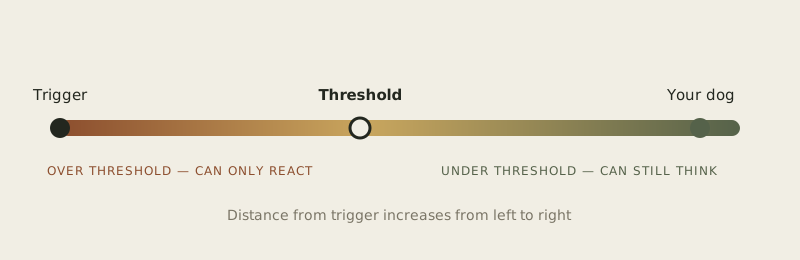
Good training happens at or just outside the threshold, where your dog notices the trigger but can still take a treat, respond to a cue, or make a choice. Push past it too often, and you’re not training — you’re just letting your dog practice the reaction. Finding your dog’s threshold distance covers the full step-by-step process for locating it and working there safely.
Push past it too often, and you're not training — you're just letting your dog practice the reaction.
How training approaches generally work
Most effective reactivity training combines a few core mechanisms, usually layered together rather than used in isolation:
- Desensitization — gradual, controlled exposure to a trigger at a distance the dog can handle, slowly closing that distance over time as the dog stays calm.
- Counter-conditioning — pairing the trigger’s appearance with something good (usually high-value treats) so the dog’s emotional association with it shifts over time, not just their behavior.
- Impulse control and engagement exercises — building a dog’s general capacity to notice something exciting or frustrating and still check in with you, which matters especially for frustration-based reactivity.
- Management — reducing how often a dog is exposed to a trigger at full intensity while the training above is still in progress, since every full-blown reaction is a rehearsal of the pattern you’re trying to change.
The American Veterinary Society of Animal Behavior has a clear position statement on humane dog training worth reading if you want the broader research context behind why reward-based approaches like these are the current standard of care, rather than corrections or punishment-based methods.
A realistic timeline
Reactivity training is rarely fast, and progress usually isn’t linear. Many owners see meaningful change within 8-12 weeks of consistent, correctly-targeted work, but a full shift in how a dog responds to a trigger can take several months to a year for dogs with a longer reactive history or more intense triggers. Expect good weeks and setback weeks — a single bad encounter doesn’t erase progress, and a quiet week doesn’t mean you’re finished.
Where to go from here
- Living somewhere without a yard or quiet streets? Start with apartment training, or training with no yard at all if you’re in a house without one.
- Confused about your dog being reactive on leash but fine off-leash? That’s a specific and common pattern — read the leash vs. off-leash guide.
- Ready to work on distance and thresholds directly? Finding your dog’s threshold distance covers the step-by-step.
- Want a lower-stress way to build up recovery time between training sessions? A weekly decompression walk is a simple addition worth starting.
- Considering a muzzle, a better harness, or a training course? See the muzzle training guide, the harness guide, and the Brain Training for Dogs review before you buy.
- Wondering if your dog’s breed has anything to do with it? See which breeds are prone to reactivity, and why.
When to bring in a professional
If your dog has a bite history, the reactivity is escalating despite consistent management, or you feel unsafe on walks, this is the point to work with a certified force-free trainer or a veterinary behaviorist in person. Online guides — including this one — are useful for the day-to-day, but they’re not a substitute for personalized, hands-on help when things are serious.