BAT — Behavior Adjustment Training — is a specific, named training methodology developed by trainer Grisha Stewart, not a generic piece of reactivity advice. It’s built on a simple but different idea from most reactivity training: instead of only working to suppress the lunge, bark, or growl, BAT asks what the dog is actually trying to achieve with that behavior, and teaches a calmer way to get the same real payoff.
What BAT actually is
BAT is a functional-analysis approach to reactivity. Most reactive behavior isn’t random — it’s functional, meaning it works to get the dog something. For the vast majority of reactive dogs, what the behavior gets them is distance from the trigger: the barking and lunging make the scary or frustrating thing go away, retreat, or at least stop getting closer. Grisha Stewart calls this the “functional reward” — the actual payoff the dog’s nervous system is after, separate from whatever the behavior looks like on the outside.
BAT’s core insight is that if barking and lunging earn a dog distance, then a calmer behavior can be taught to earn that exact same distance instead. The dog isn’t being asked to just tolerate the trigger and get nothing — they’re being taught a better way to get what they already wanted.
Where it came from
Grisha Stewart developed BAT while working through her own dog Peanut’s reactivity, at a point where the standard approaches available to her at the time weren’t fully solving the problem. BAT grew out of that hands-on process of trial, observation, and refinement with her own dog before becoming a codified method other trainers now teach and certify in.
The core mechanic: distance as the reward, not food
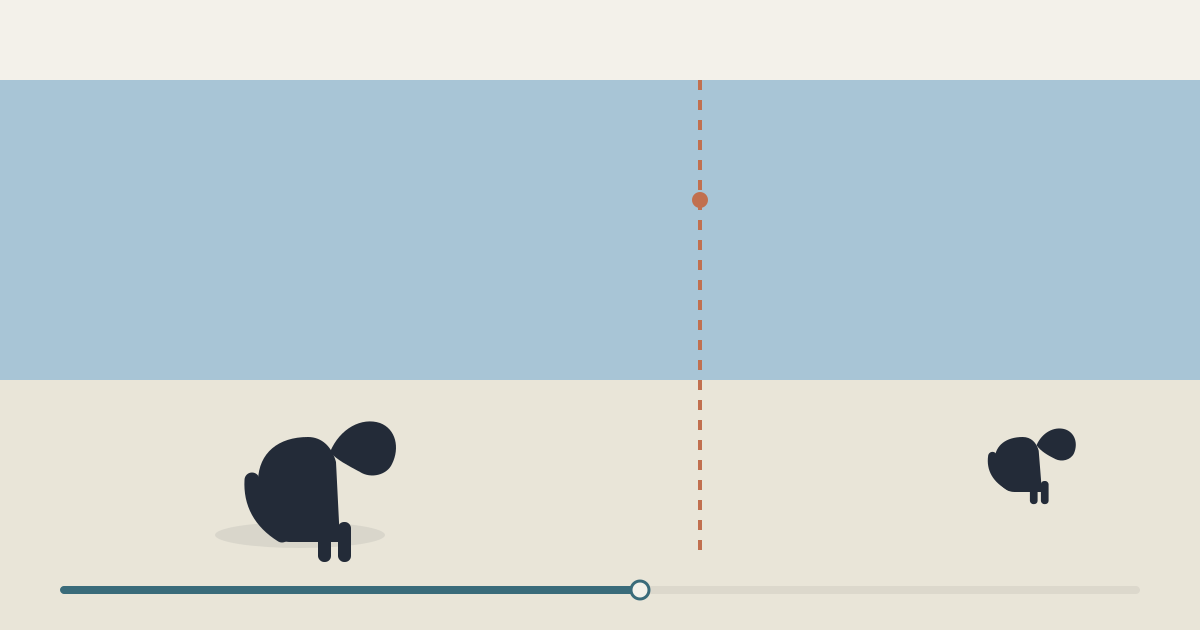
Most reactivity training — including the engage-disengage game covered elsewhere on this site — uses food as the primary reward for calm behavior near a trigger. BAT’s signature move is different: instead of rewarding primarily with treats, BAT rewards with retreat itself. If a dog near a trigger offers something calmer — a glance away, a sit, a moment of disengaging — the handler’s response is to create space, walking the dog away from the trigger as the reward.
This matters because it’s giving the dog the actual thing they wanted in the first place, not a consolation prize. Food can still play a supporting role, but the functional reward — distance — is the centerpiece, which is what distinguishes BAT from most other reward-based reactivity protocols.
BAT 1.0 vs. BAT 2.0
BAT has gone through a real revision, and it’s worth knowing the difference:
- BAT 1.0 used staged “set-ups” — a helper with a decoy dog positioned at a controlled, pre-planned distance, with the handler and dog approaching or working at that fixed setup.
- BAT 2.0 is Stewart’s revised, more naturalistic version, typically done on a long line in real-world settings rather than a staged setup. It gives the dog considerably more freedom of choice and movement, letting the dog decide how to engage with the environment rather than working through a scripted scenario.
BAT 2.0 is the current, more commonly taught version, and what most BAT-certified trainers work from today. If you come across older material describing staged decoy-dog setups, that’s likely describing 1.0.
The philosophy: agency, not just management
What sets BAT apart philosophically from purely management-based approaches is that it treats the dog as making a real choice, not as being prevented or contained into calm behavior. The dog gets to practice making good decisions with actual agency — noticing a trigger, choosing a calmer response, and experiencing that choice working. That’s explicitly about building resilience and self-reliance over time, not just suppressing the visible symptom in the moment — an approach consistent with the AVSAB Position Statement on Humane Dog Training, which favors reward-based methods that build a dog’s own coping skills over suppression-based approaches. A dog management-trained to avoid triggers may still be just as reactive underneath when management fails; a dog who’s practiced BAT reps has actually rehearsed a different response and had it pay off for real.
How this connects to threshold distance
BAT is, in a real sense, a structured way of practicing exactly what this site’s threshold-distance method already describes — working at the distance where a dog notices a trigger but can still think and choose — and then rewarding the right choice with the thing the dog actually wants. If you’ve already been doing threshold work, BAT gives that same foundation a specific, named structure and a particular reward mechanic (distance-as-reward) to build on.
A simple example walkthrough
- The dog is on a long line, giving them room to move without losing handler control.
- A helper with a calm decoy dog appears at a distance the dog can handle — within their threshold, per the same principles covered in the threshold-distance guide.
- The handler waits — without cueing anything — for the dog to offer any calmer behavior on their own: a glance back at the handler, a sniff of the ground, simply disengaging from staring at the decoy dog.
- The moment that happens, the handler rewards by increasing distance — walking the dog away from the trigger, letting the retreat itself be the payoff.
Over repetitions, the dog starts offering that calmer behavior more readily, because it’s reliably working to get them what they wanted.
Be honest about scope
BAT is a real, well-regarded, professionally taught method — there’s an official BAT school and a certification process for trainers. That’s a meaningful signal of legitimacy, but it also means doing BAT well, especially with a dog who has any bite history, benefits from guidance from a BAT-certified or otherwise qualified professional rather than a DIY-only approach from a blog post. Timing the reward correctly, reading subtle calming signals, and managing a decoy dog’s safety all take real skill to get right. If you want to go deeper than this overview, Grisha Stewart’s book Behavior Adjustment Training 2.0 is the primary source, written by the method’s creator.
One tool among several
BAT isn’t the only method that works, and it isn’t necessarily the right fit for every dog or situation. It’s one well-supported tool alongside general impulse-control work already covered on this site — some dogs and handlers click with BAT’s distance-as-reward structure, others do just as well with food-based engage-disengage work or a blend of both. Treat this as an addition to the toolkit, not a replacement for everything else here.
When to bring in a professional
If your dog has a bite history, if you’re not confident reading subtle calming signals in the moment, or if you want to try BAT specifically, working with a BAT-certified trainer (or a certified force-free trainer familiar with the method) is the safest way to start — a decoy-dog setup involves real risk to manage correctly, and that’s not something to improvise solo.
Related reading
Start with finding your dog’s threshold distance if you haven’t already — it’s the foundation BAT builds on. For the food-reward alternative to BAT’s distance-as-reward mechanic, see the leash vs. off-leash guide, and for a long line to pair with BAT practice, see what to look for in a 15-30 foot long line.